Published on
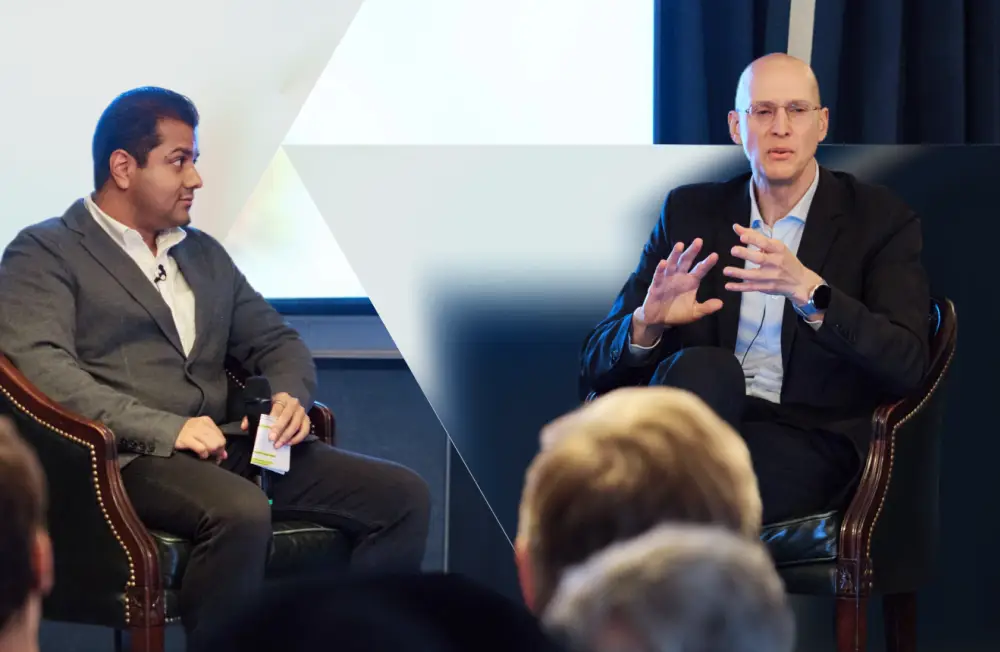
At the start of our session in London, I asked the room a simple question: for what share of your daily tasks do you use AI? The first answer from the floor was 60%. That is a remarkably high number, but it is not an outlier. It is close to what the data show for the most AI-exposed jobs in finance.
Kunal and I used three figures to anchor our conversation. Each makes one point:
-
AI is improving faster than any technology we have lived through. But its productivity gains are jagged, and capturing them requires human judgment.
-
AI is already reshaping workflows in finance. What it does to a job depends on where in the workflow it is deployed. In wealth management, that choice decides whether a firm builds a scalable, trusted service or falls into a mediocrity trap.
-
AI is already reshaping organizations, starting with the entry-level jobs through which firms train their future senior people. Redesigning the organization is not an optional extra. It is part of how a wealth manager shows clients that it really understands AI.
1. The technology: exponential progress, jagged gains
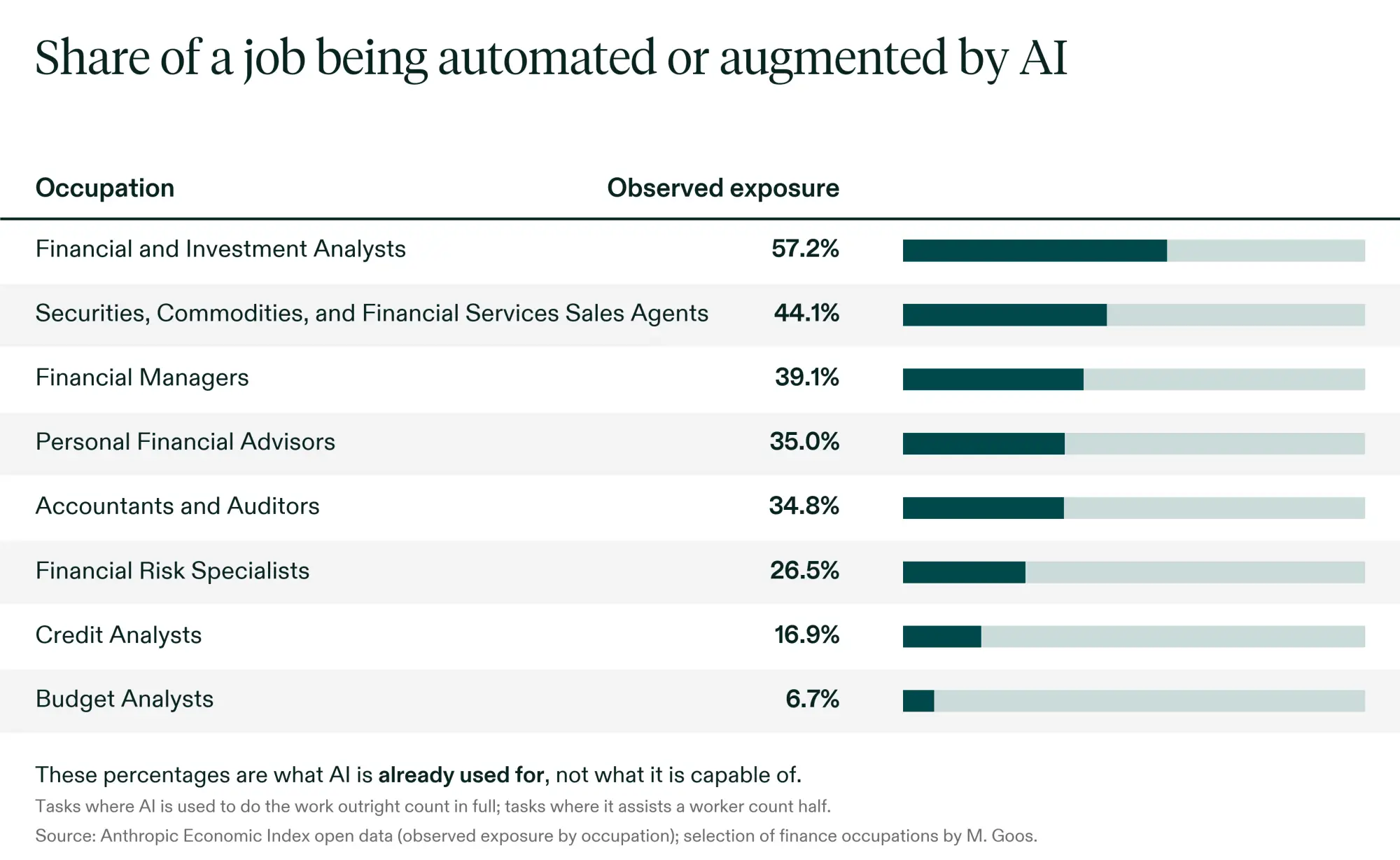
The length of tasks AI can complete is doubling roughly every four months. Source: METR.
How fast is AI improving? The figure above comes from METR, a research organization that tracks the capabilities of AI models. Each dot is a model, placed at its release date. The vertical axis measures how capable it is in an intuitive way. Researchers give each model a large set of tasks. Some it completes almost every time and others it almost always fails. In between sits a task the model completes half the time. The vertical axis shows how long that task takes a human expert.
In 2019, GPT-2 could reliably complete tasks that take a person a few seconds. Today’s frontier models complete tasks that take an expert close to a full working day. The vertical axis is logarithmic, so the straight line through the dots is exponential growth: the length of tasks AI can complete doubles roughly every four months (every 125 days on the fit since 2023). No earlier wave of technology, whether electricity, computers or the internet, improved this quickly.
Will it continue? I put that question to Kunal. His answer pointed to what sits behind the curve: investment. Spending on AI infrastructure (data centers, chips and the energy to run them) has reached a little over 3% of US GDP. That is more than in any previous technology boom.
Kunal GosarHistorically we’ve seen a lot of scaling limitations start to get hit as AI models progress: data limitations, infrastructure limitations. The level of investment is really superseding and offsetting that. … It’s very difficult to predict where things are headed, but it’s a pretty reasonable belief that things will continue to accelerate.
Later in the session, Kunal turned this into a planning horizon. A doubling every 125 days leaves organizations “basically one and a half quarters to adapt”. By the end of 2027, the models could handle tasks roughly eight times longer than they can today.
Does faster AI make firms more productive? The progress in this figure only pays off if it makes firms more productive. Here the research is encouraging. In one large experiment, more than 500 professionals (consultants, data analysts and managers) were given different generations of AI models to do their work. Each additional year of model progress cut the time needed to complete a task by about 8% (Merali, 2025). So the progress in the METR figure translates directly into productivity gains on real professional tasks.
But the gains are jagged. One of the best-known studies of AI at work tested consultants at Boston Consulting Group (Dell’Acqua et al., 2026). The consultants were split into two groups, and each group got a different task. Within each group, some consultants had access to AI and some did not.
-
Group one had to design a new shoe and write a marketing plan to bring it to market. With AI, the consultants did much better. Industry executives judged their plans to be clearly superior.
-
Group two had to advise the CEO of a company with five brands on which brands to invest in. They had to combine a spreadsheet of financial data with interviews of the company’s managers. With AI, the consultants did worse. They more often recommended the wrong brands.
Both are everyday consulting tasks, and the same AI tool had opposite effects on them. The first task lies inside the technology frontier and the second lies outside it. That frontier is not a straight line. It is jagged, and it is not obvious in advance where it runs. People have to learn to navigate the jagged frontier. They have to find out where AI can be trusted and where human judgment must take over.
I asked Kunal whether engineers, who build these systems, have a better sense of where the frontier lies. His answer was that this understanding is uneven, even inside a technology company, and that it is a matter of software-skill maturity:
Kunal GosarUnderstanding the jagged-frontier aspects of AI is about getting more and more mature about how to apply it, and also where human judgment is still really key to getting the outcomes we want to deliver.
What this means for managers. The productivity gains are real, and they grow with every generation of models. But they are not automatic, and the two interact. Because the technology improves so fast, the jagged frontier keeps moving. A task that sat outside the frontier last year may sit inside it now. Knowing where the frontier lies is therefore not a one-off training exercise. It is a skill that firms and their people must keep renewing. As the next section argues, in wealth management that skill decides where in the workflow AI should go.
2. The workflow: where AI lands decides what happens to the job
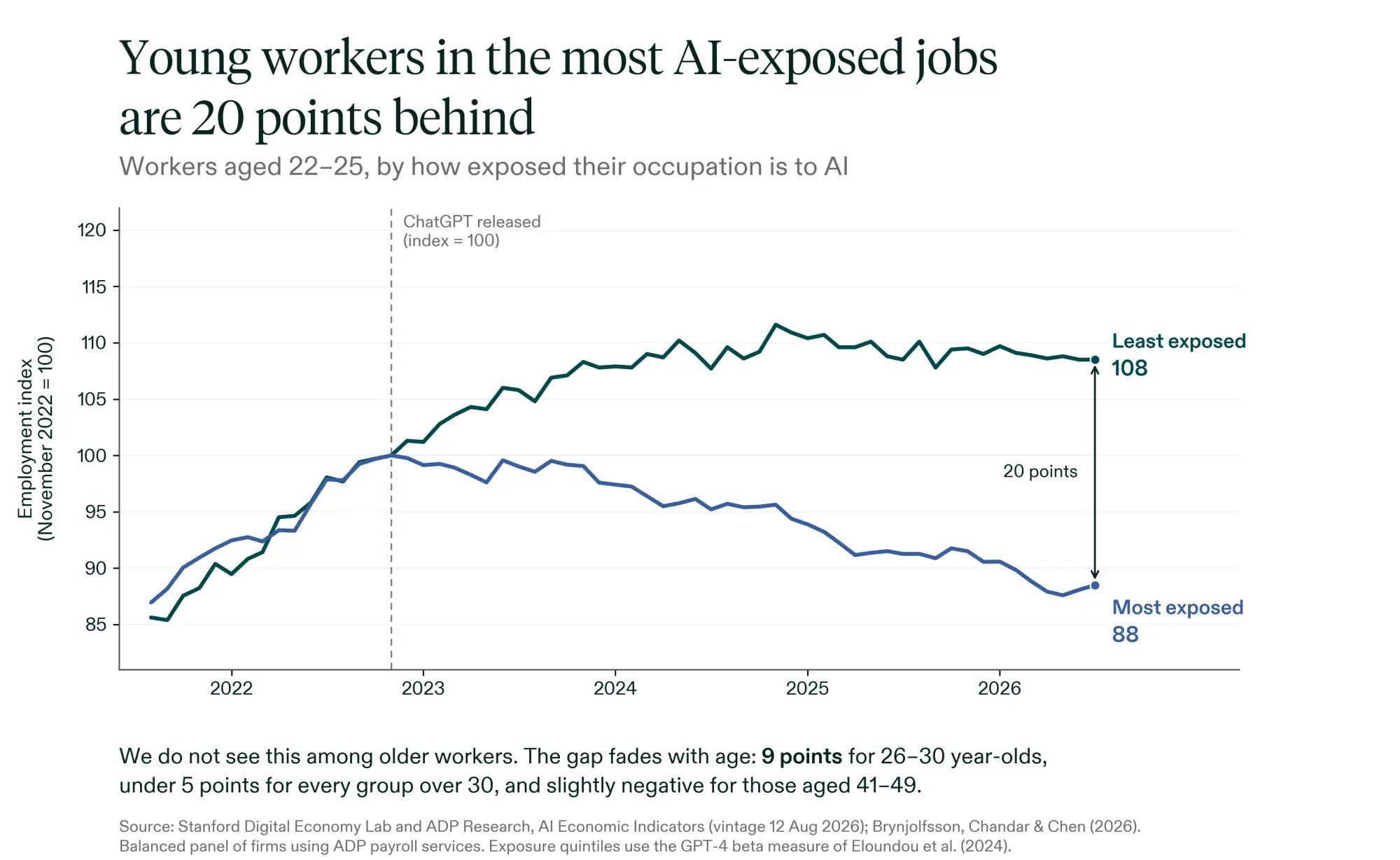
Share of a job being automated or augmented by AI, for eight finance occupations. Source: Anthropic Economic Index.
AI is already part of the daily work in finance. This figure uses data on how people actually use AI at work, from the Anthropic Economic Index. For each occupation, it shows the share of tasks for which AI is already used, not what it might be capable of in theory. Financial and investment analysts use AI for 57% of their tasks. Personal financial advisors, the occupation closest to wealth management, use it for 35%. Finance is among the sectors with the highest AI use in the economy, together with other business services such as accounting and law.
This does not mean that AI will automate away these jobs. To see why, one must distinguish between a task and a job.
A task is not a job. In 2016, Geoffrey Hinton, one of the founders of deep learning, said that we should stop training radiologists because AI would soon read scans better than they can. On reading scans he was probably right. But reading scans is one task in a bundle of tasks. Radiologists also make diagnoses, sign off on them, consult with colleagues and explain the results to patients. Since 2016, the number of radiologists has gone up. The ones who do best combine AI-read scans with their own expertise in diagnosis and patient care.
The same AI can have opposite effects on a job. David Autor at MIT and his co-author Neil Thompson give a framework for this. What AI does to a job depends on which part of the bundle of tasks it takes over:
-
When AI takes over the routine part of a job, as with radiologists reading scans, the people who remain concentrate on the expert part. Their expertise becomes more valuable, their productivity rises, and the job becomes more specialized and better paid.
-
When AI takes over the expert part of a job, the job opens up to many more people. When I was a PhD student in London twenty years ago, driving a black cab required “The Knowledge”: every street in London memorized, along with how to get through them at rush hour. Today, anyone with a car and a smartphone can drive a taxi. The expertise now sits in the app. Many more people can do the job, competition intensifies, and the job is worth less, unless there is some barrier to entry.
So the question for managers is not whether AI will affect a job, but where in the job it lands.
Wealth management as a workflow
The tasks of a wealth manager form a workflow that ends in a product the client values. At the start of that workflow are the investment decisions: building and managing portfolios to maximize returns for each client’s goals and constraints. At the end of the workflow is what I call the last mile: a personal, often in-person relationship with the client, based on trust. The client experiences this relationship, and the client pays for it.
AI can enter this workflow in two very different ways.
Design 1: AI upstream, the advisor owns the last mile. In this design, AI makes the upstream investment work far more powerful. It makes truly personalized portfolio optimization possible at scale. The wealth manager does not hand that work over blindly. They stay in the loop and know how to use AI well, including where it can be trusted and where it cannot. This frees the wealth manager to specialize in the last mile: understanding clients, explaining decisions, being there when markets fall, and building a client base. This is how an in-person service becomes scalable. It is the radiologist case. AI takes over the routine part of the bundle, and human expertise concentrates where it is most valuable. Platforms such as Addepar’s are built for this kind of workflow.
Design 2: AI end-to-end, the advisor is out of the loop. Now imagine a wealth manager who automates both ends of the workflow. Upstream, an AI agent makes investment decisions with little human oversight. Downstream, communication with clients is automated too, for example through an app that reports performance and answers questions. This design carries several risks.
-
Data security. To automate investment decisions, an AI agent needs autonomous access to clients’ financial data. That raises serious questions about security and control. Kunal made a related point during the Q&A. Security, governance and data controls have to be built into the platform layer before AI can be deployed with confidence on top of it.
-
Loss of expertise. If the AI has discretion over investment decisions, the wealth manager is no longer in the loop. Over time they lose the knowledge and judgment that clients expect when they sit across the table. The expertise that should feed the last mile disappears.
-
The verification problem. Wealth managers rely on AI to inform their clients. Clients, in turn, use AI to check what their wealth managers are doing. On both the supply and the demand side, humans drop out of the loop, and AI ends up verifying AI.
The result is what I call a mediocrity trap. This is the taxi case. Once the expertise sits in the software, the service becomes a commodity that anyone can offer. Competition intensifies, and there is little left to set one firm apart from another.
Which design wins? I doubt that the market will leave much room for mediocrity in wealth management. At its core, wealth management, like much of finance, is a relational service based on trust. Trust is the one thing in this workflow that AI cannot supply. The firms that succeed will use AI to get the most out of the upstream investment work. Above all, they will use the time and insight it gives them to excel at the last mile, a personal service informed by their understanding of what AI does upstream. The firms that automate their way out of the client relationship will compete on price with everyone else who has done the same.
3. The organization: the succession problem and the credibility of redesign
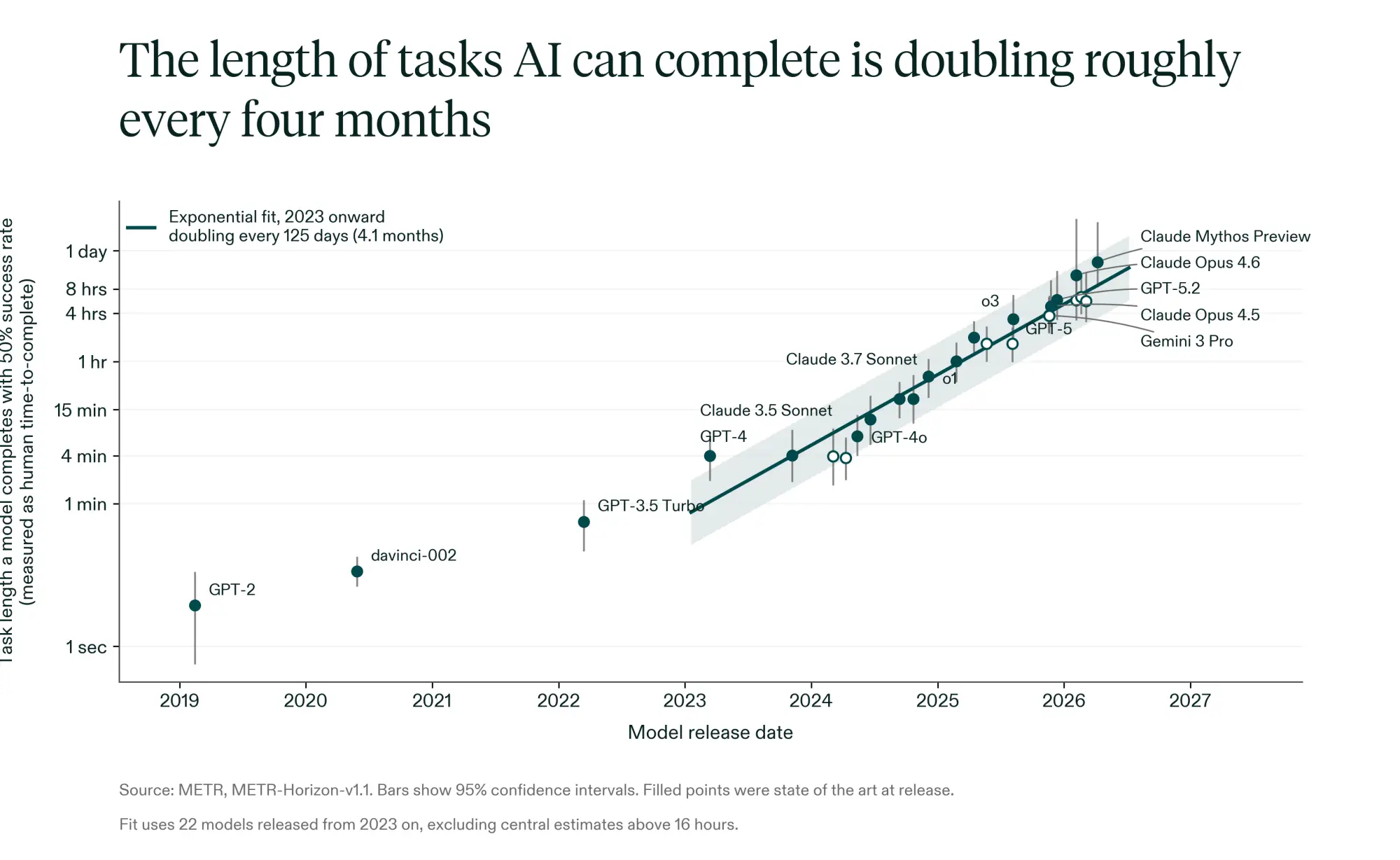
Young workers in the most AI-exposed jobs are 20 points behind. Source: Stanford Digital Economy Lab and ADP Research.
The previous section looked at one key workflow of wealth management. But wealth management firms are not single workflows. They are complex organizations, and AI’s implications reach well beyond any one of them. The clearest example is the succession problem.
What is happening to young workers? The figure above comes from Canaries in the Coal Mine?, a study by Erik Brynjolfsson and colleagues at Stanford that uses payroll data from ADP for millions of US workers. It follows employment of 22- to 25-year-olds in two groups: those in the occupations most exposed to AI and those in the least exposed. The two lines track each other closely until ChatGPT is released in November 2022. Then they diverge. Young workers in the most exposed jobs are now 20 index points behind their peers. Among older workers there is barely any gap. The gap shrinks with age and is under 5 points for every group over 30. The decline comes from fewer hires, not from more people losing their jobs. AI appears to be closing the entry door to these jobs.
Why this is a succession problem. Many professional services firms are organized as knowledge pyramids. Juniors handle the routine work: a simple contract at a law firm, a straightforward tax return at an accounting firm. Harder problems are escalated to seniors. Seniors also exercise executive and legal authority, sign contracts, and build and maintain the client network. Juniors accept relatively routine work at relatively modest pay because they are being trained. There is a career ladder, and they intend to climb it.
Now suppose AI automates the lower rungs of that ladder. In the short run, this can look like pure gain: the same work at lower cost. In the long run, it is a problem:
Maarten GoosToday’s juniors are tomorrow’s seniors. And if you don’t train those juniors anymore, how are you going to get seniors running the business?
For wealth management the problem is especially acute. The industry already faces a succession gap: senior advisors are retiring and the next-generation pipeline is smaller. And the last-mile skills described in Section 2 are learned mostly by doing, by sitting next to an experienced advisor in client meetings. A firm that cuts its juniors to save costs today is cutting the pipeline for the very skills that make it competitive tomorrow.
How firms are responding. The large accounting firms offer an instructive example. For them the career ladder is essential, so they keep hiring juniors but redesign their jobs to be more training-intensive. The training has two parts:
-
Navigating the jagged frontier. Juniors do not need to become programmers, but they must know when AI is useful and trustworthy and when it is not.
-
The skills AI cannot provide. These include communication, running effective meetings, resolving disputes, building client relationships and, as an audience member rightly added, creativity. Some of this training is formalized, for example in buddy programs that pair a junior with a senior.
Kunal described the same shift in software engineering, one of the first disciplines where AI has made a large impact. Companies increasingly look for AI-native talent: early adopters who can navigate the jagged frontier, and people with the agility to keep learning new ways of working. And he stressed the long-term logic:
Kunal GosarYou’re making those early investments in talent in your own organization as future leaders, not just to do the work of today.
Why do these skills matter so much. The research on who succeeds with AI points to the same combination. The people who do best know what AI can and cannot do, and they also have strong managerial skills. Organizations exist to handle the transactions that are too complex for the market, where departments have opposing interests and someone has to communicate, negotiate and decide. That is precisely the work AI cannot do.
The shape of the organization is changing too. Earlier waves of information technology made organizations flatter and widened the span of control of managers. Whether AI will do the same is still an open question in the research. Kunal’s view from the technology industry is that it is already happening: smaller, nimbler, higher-agency teams, accelerated by AI tools, and a growing divide between the most and least AI-mature organizations.
Kunal GosarHaving the technology-aware and the job-aware maturity together is going to be the biggest accelerator.
Who can lead such a redesign? Leading an organizational redesign requires a rare combination of three kinds of knowledge:
-
deep knowledge of the firm’s workflows and where its bottlenecks are;
-
knowledge of the technology and of where the jagged frontier lies;
-
knowledge of the company as a political entity: who stands to gain or lose, and where resistance will come from.
This expertise is scarce, and AI certainly cannot automate it. Resistance is one of the main bottlenecks to realizing AI’s productivity gains. One response is to roll out AI together with a programme of internal “AI champions”, as some banks are doing.
Redesign as a signal of credibility
There is one more reason why organizational redesign matters for wealth managers. It is part of how they avoid the mediocrity trap. A wealth management firm can only credibly tell its clients that it understands AI if it can show that it is willing to invest in redesigning its own organization because of AI. That means how it hires, how it trains juniors, how it structures teams and how it keeps human judgment in the loop. Clients who are asked to trust a firm with their wealth will rightly ask how that firm is preparing its own people.
Addepar sits at the center of wealth and investment management workflows, where firms consolidate, structure and report on holdings across custodians and private markets. That position shows what AI needs to work well, which is connected, trusted data, and where firms struggle to adopt it. Pairing the technology with those lessons helps clients not only deploy AI but redesign how they work around it.
Conclusion: three lessons for wealth managers
-
The technology will keep accelerating, but its gains are jagged. Capability doubles roughly every four months, and productivity gains are real. Capturing them requires people who know where AI can be trusted, and that knowledge must be renewed as the frontier moves.
-
Where AI lands in the workflow decides the outcome. Use AI to strengthen the upstream investment work while staying in the loop, and specialize in the human last mile. Automating both ends leads to a mediocrity trap, in a business that at its core runs on trust.
-
Redesign the organization, not just the workflow. Protect the career ladder through which future senior advisors are trained. Invest in the skills AI cannot provide. Treat visible organizational redesign as part of what makes a firm credible to its clients.