
Published on
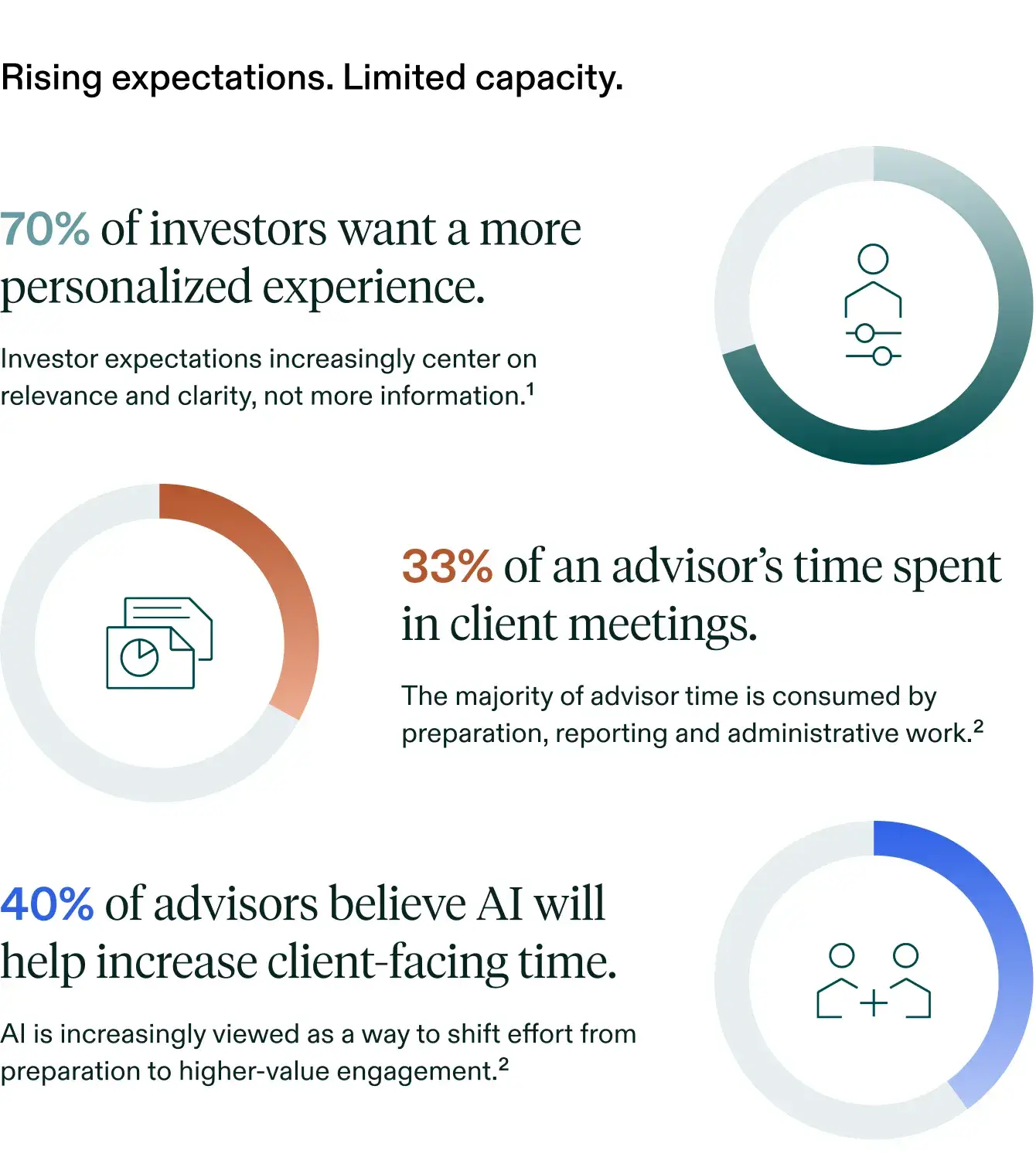
Many firms have historically equated quality experience with the delivery of more information — providing clients with more reports, dashboards and data points.
But as portfolios grow more complex and firms scale across clients, households and asset classes, the ability to personalize timely and relevant insights has become a defining factor in client confidence. Today, firms are finding that true differentiation doesn't come from more data alone; it comes from context and the clarity to act on it.
This shift is where AI can begin to redefine the personalization processes that underpin the client experience.
Personalization as a new operating principle
In investment and wealth management, personalization is typically associated with manual customization. Firms build bespoke reports or custom portfolios — a model which is often unsustainable when scaled.
Instead, true personalization allows firms to deliver a
high-touch client experience without manual intervention and
adapt insight to specific client needs without increasing
operational burden.
AI plays an integral role in
firms looking to make this shift. Effective AI tools can
continuously interpret portfolio data in context and surface
the relevant portfolio and data narratives for each
stakeholder, whether client-facing, investment-focused or
operational.
A single source of truth, with different perspectives
A single client portfolio can drive very different priorities across a firm:
-
Firm owners may prioritize a macro view of risk exposure and scalability, with a focus on client confidence
-
Advisors look for the story behind the data, with clear, benefit-led insights that enable meaningful strategic conversations
-
Investment and operational leaders need accuracy and transparency from a unified dataset to evaluate performance, scenario risk or operational results
Historically, supporting these perspectives required parallel workflows and repeated analysis, limiting a firm’s ability to scale without adding complexity.
AI introduces a more efficient model: a shared intelligence layer that adapts insights to role and responsibility, preserves a single source of truth and increases operational leverage across the firm. The result is better reporting, better client conversations and enhanced efficiency firm-wide.
Balancing true personalization with governance
Client experience is no longer defined by the quality of a static quarterly report. Instead, it is tied to a firm’s ability to anticipate questions, explain market shifts and communicate confidence in real time. Achieving this requires moving beyond static outputs toward continuous insight — intelligence that evolves as portfolios, markets and client needs change.
In a regulated environment, this evolution must be grounded in trusted data, clear permissions and transparency. For firms to scale successfully and maintain trust, intelligence and personalization must be governed effectively and securely.
Elevating human expertise
AI is not a replacement for the client relationship; it strengthens it. By reducing the time spent assembling and validating information, AI allows professionals to focus on their highest-value work: judgment, strategy and trust.
For firms, this translates into more consistent client experiences, stronger internal alignment and greater confidence at scale.
Looking ahead
As industry expectations continue to shift, personalization will move from a competitive advantage to a foundational requirement. Firms will increasingly expect their technology to understand context, adapt to role-specific needs and surface insights proactively.
The next generation of platforms will act as intelligent partners across the entire investment lifecycle, helping firms navigate complexity with greater clarity and control.
Find out more about AI at Addepar.
References:
1. Transformation on Your Terms: Investor Expectations Driving the Agenda, Broadridge Financial Solutions, 2025.
2. IFA DNA 2025 Report, Fidelity Adviser Solutions / Fidelity International, 2025.